
Plan Banff in winter, December to March: real temperatures and daylight, ski and non-ski days, winter driving rules, getting around car-free, and where to stay.
We're a family-owned hotel at 401 Banff Avenue, and this is the season plan we give our guests. In this guide:
What Banff is like in winter, month by month
The best things to do, for skiers and non-skiers
Getting around without a car, and winter driving rules
Park passes, packing and where to stay
If your dates are fixed, our month guides go deeper: Banff in November covers the early-season shoulder weeks, and Banff in December covers the Christmas market and holiday events.
What is Banff like in winter, month by month?
Banff's winter is cold in December and January and noticeably softer by March. Parks Canada's climate figures for the Town of Banff show average daily highs of -5.3°C in both December and January, rising to 3.8°C in March (Parks Canada weather). Daylight changes even more than temperature.
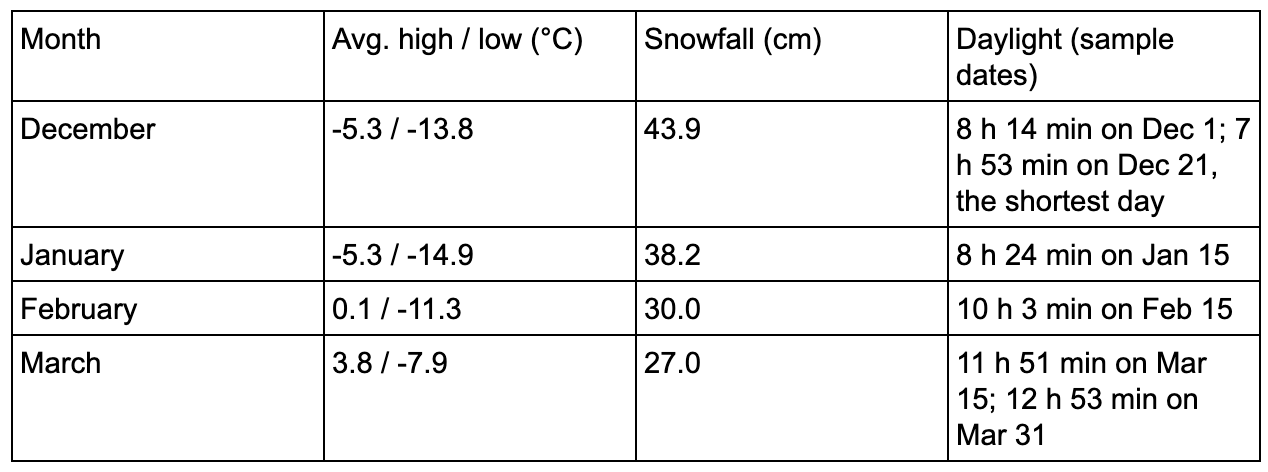
Temperatures and snowfall: Parks Canada, Town of Banff (1,397 m). Daylight: timeanddate.com, 2026-27 season.
What that means for planning:
December and January are the darkest, coldest weeks. Plan one big outdoor block around midday and keep mornings and evenings for breakfast, hot tubs and dinner.
February is the turning point. Average highs reach about freezing, and mid-February has about 1 h 40 min more daylight than mid-January, which suits longer ski days and lake walks.
March is the mildest month, and by March 31 you have five more hours of daylight than at the solstice, while the ski season is still on. Our Banff in April guide picks up where March leaves off.
What are the best things to do in Banff in winter?
The best things to do in Banff in winter are skiing at the three nearby ski areas, soaking in the Banff Upper Hot Springs, skating and walking on frozen lakes, and the SnowDays festival in late January. For a week-long trip, we suggest two or three ski days mixed with slower days in and around town.
Ski days
Three ski areas sit within reach of downtown Banff: Banff Sunshine, Lake Louise Ski Resort and Mt. Norquay. For the 2026/27 season, SkiBig3 reported Lake Louise open on November 1 and listed Banff Sunshine's opening day as November 7; check each resort's snow report for what is open on your dates. Lake Louise has also added its Richardson's Ridge terrain, 200 acres served by a new high-speed quad (SkiBig3).
Banff Sunshine sits on the Continental Divide with over 3,300 acres of skiable terrain (our things to do page has more).
Lake Louise Ski Resort is the longest ride from Banff of the three, so plan it as a full day out.
Mt. Norquay is the closest to town, which makes it a good pick for a half day or lessons.
Getting there without a car is simple. The SkiBig3 ski shuttle runs from Banff hotels to all three ski areas. It is complimentary with a SkiBig3 lift ticket or season pass, an Ikon Pass, a Mountain Collective pass or a Rocky Mountain Passport. Seats are first come, first served, so be at the stop about five minutes early, and check times with SkiBig3 because shuttle dates and times can change without notice. Ask our front desk which stop to use.
When you're back, our secure ski lock-up with a tuning workbench keeps wet gear out of your room.
Non-ski days
Not a skier? Banff in winter still fills a week. These are the non-ski days we suggest most often:
Banff Upper Hot Springs. Parks Canada lists daily hours of 10am to 10pm, last entry 9:30pm, holidays included. There are no online bookings or advance tickets, so just turn up.
Johnston Canyon icewalk. Check first this season. Parks Canada issued an area closure for the Johnston Canyon trail and day-use area on October 13, 2026 (Banff bulletins), so confirm it has reopened before you plan the frozen-waterfall walk.
Frozen lakes. Skate or walk only once ice is declared safe; there is no fixed date. Our Banff or Lake Louise guide helps you decide how to split a day between the two.
Banff Gondola, museums and cafés. Good for the coldest afternoons, when a view from Sulphur Mountain or a long coffee beats another hour outside.
Travelling with children? Our Banff with kids guide has family-sized versions of these days.
Winter festivals after the holidays
Banff's big winter festival is SnowDays, which runs from January 21 to February 7, 2027 in Banff and Lake Louise (SnowDays).
Snow sculptures on Bear Street for the full festival, a short walk from Banff Avenue.
SnowDays Play Zone in Banff Central Park, Thursday to Sunday.
Ice Magic at Lake Louise, February 3 to 7, 2027.
Plan ahead for Ice Magic. The event page says there is no parking at the site and every ticket holder uses the shuttle. Complimentary tickets go to guests of participating Lake Louise hotels and to local residents on set dates, and the other way in is a guided tour package from a participating operator, so from Banff a tour package is the simplest route. The Hot Chocolate Trail also runs until February 7, 2027, and Whitebark Cafe in our lobby is an easy first stop.
Do you need a car in Banff in winter?
No, you do not need a car in Banff in winter if you stay downtown. Three ways to get around without one:
On foot to restaurants, shops and cafés on Banff Avenue.
The SkiBig3 shuttle to the ski areas, complimentary with the tickets and passes listed above.
Roam, Banff's public transit (roamtransit.com). Routes and timetables change by season, so check the current winter schedule before you rely on it, and ask our front desk for the nearest stop.
Airport shuttles from Calgary also come to the hotel; see the FAQ below.
Can you drive to Banff in the winter?
You can drive to Banff in winter on the Trans-Canada Highway from Calgary, but the legal tire rules depend on which highway you use. Parks Canada's driving page sets out two windows:
November 1 to March 31: snow tires or chains are required by law on Highway 93N (Icefields Parkway) and Highway 93S (Banff-Windermere Highway) inside Banff National Park, or any time those roads are covered in snow or ice.
October 1 to April 30: the same requirement applies on Highway 1 through Yoho National Park and Highway 93S through Kootenay National Park, the routes into Banff from British Columbia.
Snow tires carry a snowflake or "M+S" symbol, so check before you leave the rental desk. Parks Canada also warns about black ice on bridges, early sunsets and wildlife near roads at dawn and dusk. Check 511 Alberta for conditions on the day.
Do you need a park pass for Banff in winter?
Yes, you need a national park pass for Banff in winter, as in every season. Daily admission is $12.25 per adult or $24.50 for a family or group of up to seven in one vehicle, and youth aged 6 to 17 enter free (Parks Canada fees). The annual Discovery Pass costs $83.50 per adult or $167.50 per family or group.
The break-even point is about a week:
One adult: seven daily passes cost 85.75,sotheDiscoveryPass(83.50) is cheaper from day seven.
A family or group: seven daily passes cost 171.50,sothefamilyDiscoveryPass(167.50) is cheaper from day seven.
For a shorter winter trip, daily passes are the better buy. All prices are in Canadian dollars.
What should you pack for Banff in winter?
Pack for mornings around -15°C and warm indoor evenings. The basics:
Insulated, waterproof boots and microspikes or ice cleats for icy paths.
A warm parka, base layers and a mid-layer you can take off indoors.
A toque (warm winter hat), mitts and a neck warmer.
Sunglasses and sunscreen, because snow glare is strong even in January.
Swimwear for hot tubs, saunas and the hot springs.
Our November guide has a longer cold-weather packing list.
Where should you stay in Banff in winter?
Stay downtown in Banff in winter so you can walk to dinner, catch ski shuttles in town and skip scraping a car at -14°C. Here is what a winter stay looks like at Banff Aspen Lodge on Banff Avenue:
Two outdoor hot tubs with a fireplace, plus a steam room and an outdoor Nordic sauna around the courtyard (hotel amenities).
A hot buffet breakfast included with every stay, from 6:30am daily (until 10:00am on weekdays, 10:30am on weekends).
Secure ski lock-up with a tuning workbench, and a front desk staffed 24/7.
Rooms for different groups: Superior Rooms have a private balcony or patio, and Premium Rooms sleep up to four. See all rooms.
Dogs welcome in select rooms, $25 per night per dog, two dogs maximum; call us before booking.
Plan your winter stay in Banff
A good Banff winter day ends warm: a soak by the fire after the slopes, and a hot breakfast before the next shuttle. If you're planning your season dates, our best time to visit Banff guide compares winter with the rest of the year, and our team is happy to help with ski shuttles, park passes and road conditions when you arrive. Book your winter stay at Banff Aspen Lodge.
FAQ
Frequently asked questions about Banff in winter
Which airport is best to fly into for Banff?
Calgary International Airport (YYC) is the best airport to fly into for Banff, about 140 km from our hotel and roughly 1.5 to 2 hours by road on Highway 1. It is the nearest major international airport to Banff National Park.
Is there a shuttle service from Calgary Airport to Banff?
Yes, several shuttle services run from Calgary International Airport to Banff, and they drop off and pick up directly at Banff Aspen Lodge. It is the easiest way to arrive in winter without renting a car.
Which is nicer, Lake Louise or Banff?
Banff is the better winter base, with more restaurants, hotels and transit, while Lake Louise is the better day trip for its frozen lake and ski resort. A common plan is to stay in Banff and spend a day at Lake Louise. Our Banff or Lake Louise guide compares them in detail.